A Small Glossary for Listening to Match Commentary
A small glossary for listening to match commentary helps you separate what happened from what it means and what may happen next.
The ball clips the outside of a post, and the commentator says, “That was close.” A moment later: “They have looked the sharper side.” Then, as the teams reset: “This could be the opening they need.” Those remarks may arrive in one breath, but they do different jobs. A small glossary for listening to match commentary starts with hearing those jobs separately.
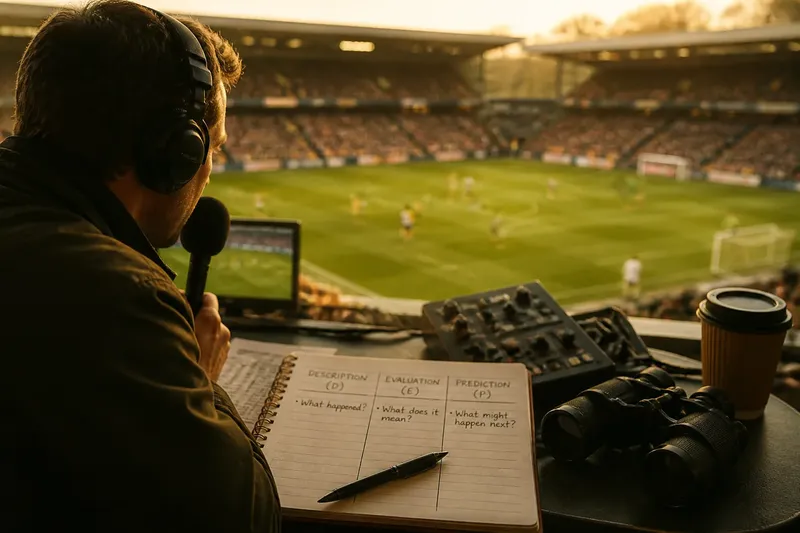
Try the exercise during a passage of play rather than waiting for a quiet, scholarly afternoon. Keep your attention on three kinds of language: description, evaluation and prediction. The distinctions are not rigid. They are useful handles, like the labelled drawers in a kitchen where the cutlery is otherwise all in one place.
What is the commentator doing with this sentence?
Commentary usually moves between what can be seen, what the speaker thinks it means and what may follow. A single phrase can blend these layers, but identifying its main purpose makes the commentary easier to hear clearly.
- Description: reports an action or observable condition: “She takes it on her left foot,” or “The serve catches the tape.”
- Evaluation: judges quality, significance or responsibility: “A loose pass,” or “Excellent timing.”
- Prediction: points towards a possible next event: “He may try the cross-field ball,” or “They will want to slow this down.”
For a short listening exercise, choose a small stretch of a match and listen for one sentence at a time. Silently tag each one D, E or P. If a sentence seems to fit two tags, note both rather than forcing a clean answer. The purpose is to notice the shift, not to mark the commentator’s paper.
It helps to begin with plain verbs. “Passes”, “clears”, “turns” and “shoots” usually describe. “Wasteful”, “composed” and “ambitious” usually evaluate. “Could”, “might”, “will” and “looks set to” often signal prediction. These are clues, not a mechanical test: “He will have to clear that” may describe an obligation more than forecast an action.
How does description differ from evaluation?
Description names what happened in terms another viewer could check against the play. “The defender steps across and wins the ball” gives an action and its outcome. Evaluation adds a judgement: “A timely challenge.” The challenge may be the same; the adjective tells you how the speaker rates it.
Listen for words that grade an action: “tidy”, “sloppy”, “brave”, “poor”, “clever”, “wasteful”. Also notice verbs carrying an opinion. “Nicked the ball” suggests a sharp, perhaps opportunistic intervention; “gave the ball away” puts the error in the foreground. Neither phrase is merely a neutral inventory of movement.
Imagine a player sends a pass beyond a teammate and out of play. One commentator says, “The ball runs through to touch.” Another says, “That was a careless pass.” The first reports where the ball went; the second assigns quality and, indirectly, responsibility. If the surrounding play was fast or the receiver changed direction, more context could alter that judgement. The distinction does not settle who was right. It lets you hear where judgement entered the account.
A useful question is: could a camera angle confirm this exact sentence? It may confirm that the pass went out. It cannot settle whether the pass was careless without some account of intention, pressure and available options. Commentary often supplies that account quickly, so its judgements can sound like part of the visible action.
Which words point forward?
Prediction is not always a bold forecast. It often arrives in cautious wording: “They might go long here,” “She looks likely to attack the second serve,” or “That should give them room on the left.” Listen for modal verbs such as “might”, “could” and “should”, along with phrases like “is expected to” and “will be looking to”. They mark an outcome as possible, intended or anticipated rather than completed.
Separate a prediction from a plan. “They will want to keep possession” describes an inferred intention. “They will keep possession” sounds more like a forecast. In live speech the difference can blur, and “will want to” sometimes functions as a prediction about tactics rather than a claim about what a team actually wants.
Prediction also helps commentary bridge pauses. A player shapes to shoot; the commentator says, “He’ll look for the far corner.” That phrase may prepare you to watch the goalkeeper’s position, but the eventual shot could go elsewhere. Treat the words as a suggested lens on the next moment, not as a report that the moment has already happened.
How can one phrase do several jobs?
“A clever ball, and she is through” combines evaluation and description. “They have been patient; now they could break” moves from a judgement about the side’s approach to a forecast. Rather than assigning every sentence to one box, listen for its main clause and its add-ons. Adjectives often evaluate; the reported action often describes; modal wording often predicts.
These categories can also expose a shift in certainty. A commentator may begin with “It looks as though” and then state the next action more firmly. They may revise a prediction once the play changes, or use a judgement after seeing its outcome. That is ordinary live commentary, not a contradiction that needs a courtroom.
For practice, choose a brief sequence with an obvious event, such as a shot, a turnover or a break in play. Write down a few exact phrases, then mark the words that carry each function. “A rushed clearance” contains a description of the action and an evaluation of its quality. “The clearance gives them a chance to counter” adds a consequence that is partly predictive.
What should you listen for during a match?
Use these questions as a compact field note. They work across sports, though the vocabulary differs between a football pitch, a tennis court and an athletics track.
- What could I see? Pick out the plain action: a shot saved, a serve returned, a runner passed.
- Which word adds judgement? Notice adjectives and loaded verbs, then ask what they imply about skill, choice or responsibility.
- What is being forecast? Listen for “may”, “could”, “should” and “looks likely”, and note whether the speaker means an intended tactic or an expected outcome.
- What detail is missing? Consider whether the phrase leaves out pressure, a player’s position or an opponent’s contribution.
- Did the prediction happen? Compare the forecast with the next action, without treating a missed prediction as evidence that the phrase was useless.
Say you are listening to a rugby match and hear, “A strong carry, but he may have lost it in contact.” The carry is described; “strong” evaluates it; “may have lost it” leaves the outcome open. If the next view shows the ball held up, the uncertainty was part of the phrase, not an error in hearing.
Which commentary phrases are worth noticing?
What does “they have the momentum” mean?
It is an evaluation of the match’s current feel, often based on territory, possession or repeated attacks. Ask which visible events support it, since the phrase itself does not specify a single measure.
Why say “a half-chance”?
The phrase describes an opportunity while grading its quality as limited. It signals that a shot or opening existed, but that the conditions were not especially favourable.
What does “he was always going to score” tell me?
Usually, it is a confident judgement made after the outcome is apparent. Listen for whether the same certainty was present before the finish or arrived with the benefit of hindsight.
Is “they look dangerous” a prediction?
It evaluates a team as a threat and can imply that a chance may follow. On its own, it does not say when or how that chance will come.
What changes across different sports?
The three functions remain useful, but each sport has its own terms and conventions. In tennis, “break point” describes a scoring situation; “a big second serve” evaluates the delivery; “she may come forward” forecasts a choice. In cricket, “outside edge” names a contact point, “a loose ball” judges the delivery, and “the field may come up” anticipates a tactical adjustment.
Some expressions carry specialised meaning that a general glossary cannot settle. “Advantage”, “offside” and “let” depend on the sport and the situation. When a phrase hinges on a rule, use the relevant sport’s rulebook or official explanation to check its meaning; keep that separate from whether the commentator’s tone was approving or doubtful.
There is no need to write down every word. One or two phrases per passage are enough to reveal how the account moves from event to interpretation and from interpretation to expectation. The next time a commentator says “surely”, “brilliantly” or “perhaps”, you can hear not just the action, but the speaker’s particular kind of claim about it.