Why Some Sports Count Up While Others Count Down
Why some sports count up while others count down: see how score formats make a match feel open, urgent or nearly settled, and read its progress more clearly.
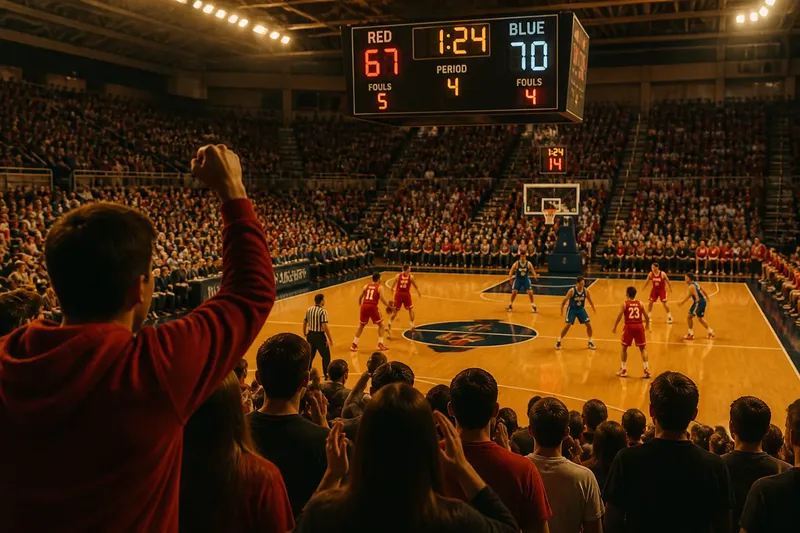
At a tennis court, the board can show a player moving from love to 15, 30 and 40; at a basketball game, the clock dwindles while the score climbs. Why some sports count up while others count down is not merely a matter of display. Each format gives spectators a different answer to the same question: how much of the contest remains undecided?
What does a score tell you at a glance?
A score is a compact account of what has happened, but its format also points towards what is still possible. Cumulative scoring adds successful actions to a running total. Countdown scoring begins with a fixed allowance of time, distance or attempts and makes the remaining amount visible. Plenty of sports combine the two: points accumulate while the clock runs down.
In a cumulative system, a growing total is the most obvious sign of progress. In a race, competitors move towards a finish line while the distance left shrinks, even if the public display emphasises elapsed time. In a timed team sport, by contrast, the clock itself supplies a visible boundary, and the score tells you how effectively the teams have used it.
These are not rival philosophies, so much as different ways to organise attention. One format foregrounds what has been earned; another makes the remaining opportunity hard to ignore. Like a kitchen timer beside a tally sheet, each gives the viewer a different useful signal.
Why do some sports count points upwards?
Count-up scoring suits contests built from repeated, separately credited achievements. A basket, goal, run or successful lift can be added to the team’s or competitor’s record. The total remains legible as the match proceeds: one side has scored more, fewer or the same number as the other.
The format also preserves the match’s accumulation. A score does not vanish when the next play begins. Spectators can follow a sequence of contributions, and the board carries the history of those events into the present. That makes a cumulative total useful in both short exchanges and long contests, though the meaning of each point depends on the sport’s rules.
Some sports use units that do not behave like a simple tally. Tennis, for instance, groups points into games and sets, with a player needing to reach particular thresholds and sometimes win by a margin. The displayed sequence is not a plain count from zero, but it still records progress through successive achievements. The system makes the structure of a contest visible as well as its current balance.
In other sports, points may carry different values, or a team may score through more than one route. A total then answers “how much?” without spelling out “how”. The live action supplies that context. A spectator who knows the scoring rules can read the total as a compressed record; a newcomer may need the scoreboard’s labels or a short explanation from someone nearby.
What does a countdown add to a match?
A countdown places the remaining chance to act in plain sight. In many timed sports, the clock descends towards an endpoint while teams continue adding points. That pairing changes the feel of the score: a lead is not just a difference between totals, but a difference that must be defended or overturned before time expires.
The clock can make identical scorelines mean different things at different moments. A narrow lead with plenty of play left is still exposed. The same margin near the end may prompt more cautious choices from the leading side and more urgent ones from the team behind. The numbers have not changed their arithmetic; the available time has changed their practical meaning.
Countdown formats can also make silence feel active. When a display approaches its end, spectators need not know every tactical detail to understand that an opportunity is closing. The clock acts like a door slowly shutting: it does not determine what happens next, but it makes the boundary visible.
Not every countdown measures time. In some events, the contest may be organised around a fixed number of attempts, rounds or remaining opportunities. Here the shrinking allowance tells the audience how many chances remain, while the score records what competitors have made of them. This can give each attempt a clear weight without requiring a continuous clock.
How do score and clock work together?
When points rise and time falls, spectators read two moving accounts at once. The score describes the current result; the clock limits the chance to alter it. Neither is sufficient alone. A team may be behind but have room to respond, or ahead with little time left to protect its advantage.
Imagine a fictional basketball match in which the Red team trails the Blue team by a small margin as the final period begins. Red’s coach asks the players to press higher, and the next few possessions become quicker and riskier. The expected observable result is not a promised comeback, but a visibly more urgent pattern of play: faster attempts, more pressure on the ball and less time spent setting up each attack. The descending clock explains why that change makes sense; the score explains why it is Red making it.
This interaction also helps explain why spectators sometimes react more strongly to a clock than to a score change. A point can be added without altering which team is favoured, while a shrinking period may remove the remaining space for another attack. Conversely, in a sport where the contest ends only when a target score is reached, the next point can be decisive regardless of elapsed time.
What should a spectator look for in an unfamiliar format?
Start by identifying what the display is counting. Is the total a record of points already scored, a measure of time elapsed, or a statement of what remains? Then look for the condition that ends the contest. A final whistle, a completed distance, a target total or the exhaustion of attempts each gives the numbers a different role.
- Read the labels: A clock marked as remaining time works differently from one showing elapsed time.
- Find the scoring unit: Goals, points, sets, rounds and attempts may each be counted on a separate part of the display.
- Check the endpoint: The contest may end when time expires, when a target is reached or after a prescribed sequence.
- Notice what can change: A score may be revised by a ruling, or a period may continue under a sport-specific rule.
- Watch the choices: Teams often change their pace or risk tolerance as the remaining opportunity narrows.
These checks are more useful than memorising a scoreboard as a picture. Once the unit and endpoint are clear, the spectator can ask what the display makes visible and what it leaves out. A running total may hide the time pressure; a countdown may conceal the accumulated work behind a lead.
What questions come up when reading score formats?
Does counting up always mean the higher score wins?
No. Some contests award points for quality or difficulty, and the winner may be the competitor with the highest total under a particular judging system. Other formats use cumulative scoring only within stages, with a later result or tie-break deciding the match.
Why do some sports show elapsed time instead of time remaining?
An elapsed clock records how long the event has been under way and can make duration or pacing easier to follow. The rules may still impose an endpoint elsewhere, so spectators need to learn whether the clock counts towards a limit or simply tracks progress.
Can a countdown exist without a clock?
Yes. A fixed number of rounds, turns or attempts creates a countdown in opportunities rather than seconds. The audience can see the remaining chances diminish even when play does not run against a visible timer.
Why can a lead feel less secure near the end?
A lead is only a comparison between current totals; it does not say how much time or how many scoring chances remain. As those opportunities narrow, the trailing side may have fewer ways to change the result, while the leader may have fewer reasons to take risks.
How can the format change the way a match feels?
Count-up scoring tends to invite attention to accumulation: a sequence of points, runs or successful attempts builds into a result. Countdown scoring makes limits conspicuous, encouraging spectators to notice what is being spent. When both operate together, the contest becomes a negotiation between the score already earned and the opportunity still available.
That difference does not decide whether a sport is tense, open or satisfying to watch. It does shape where tension gathers. A cumulative display may make a late burst of scoring stand out; a countdown may make a quiet stretch feel consequential because the chance to act is narrowing.
So, when considering why some sports count up while others count down, look beyond the direction of the digits. Ask what the display treats as progress, what it treats as a limit and which event ends the contest. Once those pieces are clear, even an unfamiliar scoreboard becomes a readable account of what has happened and what can still happen.