The Match Programme Before the Phone Screen
The match programme gave spectators orientation, records and a keepsake in one printed object, turning a day at the ground into something to follow and remember.
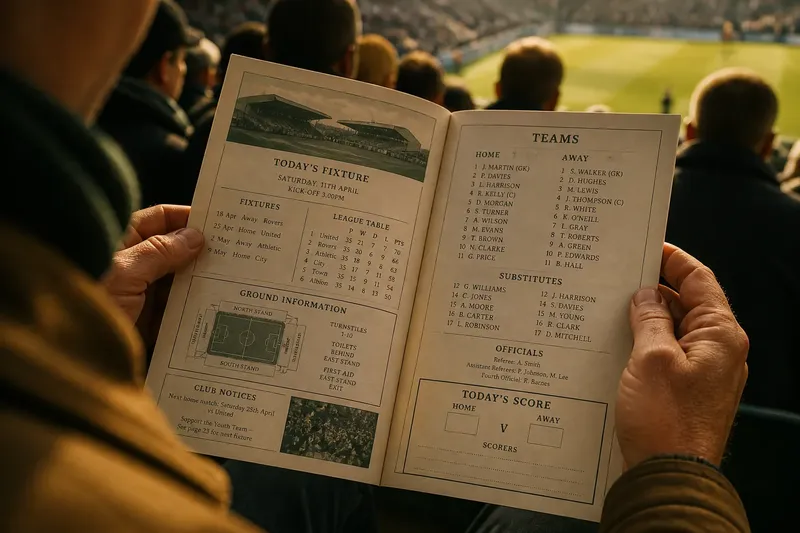
A supporter takes a seat, unfolds a match programme and checks the team sheet before the players emerge. The match programme is more than a paper version of information on a phone: it gives the day a physical order, with useful details up front and a record to carry home.
Its contents varied by sport, club and occasion, but a familiar set of jobs recurred. A programme helped spectators understand who was playing, follow what happened and connect the present contest to the club’s wider story. These six functions explain why the printed companion became part of the match itself.
1. It put the day’s essential details within reach
At its simplest, a programme answered practical questions: who was playing, where the match stood in the season and what else was happening at the ground. A fixture list could place the contest among the club’s upcoming commitments, while a table or results panel gave the afternoon a wider context.
That information was especially useful before spectators could check a device at any moment. Even with familiar opponents, a printed page gathered the relevant details in one place. The reader did not have to remember a team’s recent form or ask a neighbour what the competition meant for the season.
Local arrangements sometimes appeared alongside the sporting material: entrance information, ground maps, notices about club events or details of a commemorative occasion. The programme could orient visitors as well as regulars. Its usefulness depended on the contents being current and clear, not on lavish design.
Think of it as a paper timetable folded into a seat-pocket companion. A timetable tells you where the day is going; a programme also tells you what to watch for when you arrive.
2. It introduced the people taking part
Names are easier to follow when they have a little context. Programmes commonly printed team lists, player names and roles, sometimes with brief profiles or notes about selection. In sports with substitutes, squad lists could help spectators recognise changes as the contest unfolded.
For a newcomer, those details offered a modest way into the game. A name on the page could be matched to a shirt, position or role. For a regular, the same list made changes in the side visible: a familiar player absent, a new face included, or a captain carrying a particular responsibility.
The programme also gave clubs a place to acknowledge coaches, officials and organisers. Their inclusion reminded readers that a match involved more than the people in the playing area. Still, a printed list was a guide rather than a live feed. Late changes could make it imperfect, and spectators had to watch the announcements or the action for updates.
3. It gave the contest a record to follow
A programme’s most active page was often the one meant for annotation. Depending on the sport, it might include space to record a score, scorers, innings, laps, substitutions or other events. The format reflected the match’s own vocabulary; a football fixture and a cricket match did not need the same kind of scorecard.
Writing in the margins made spectators attentive in a particular way. A supporter might note a goal, a dismissal or a late change, then compare the final entry with the official result. The act did not make the record authoritative, but it gave the reader a personal thread through the action.
Say you arrive at a cup tie with a programme listing the starting players and a blank score panel. You mark the opening goal beside the scorer’s name, then add a substitution after the interval. By the walk home, the page shows not just who won but which moments you chose to keep.
That record could be incomplete or untidy. Ink ran, a page stayed blank, and a spectator might miss an event while looking elsewhere. Those flaws were part of the object’s character, but they also explain why programme notes should not be confused with the official record maintained by competition organisers.
4. It set the match inside a larger season
A fixture gains meaning from what came before and what may follow. Programmes often supplied recent results, league tables, cup context or notes on the teams’ standing. Such material helped readers understand why a routine league match mattered, or why a cup meeting carried a different weight.
Editorial notes could also describe a club’s priorities, a team’s recent changes or the occasion behind a special fixture. The useful versions stayed close to the match and gave readers something to consider. The less useful ones crowded the page with claims that did little to explain the contest.
For supporters who attended irregularly, these pages provided a compact way to catch up. For those who followed every fixture, they offered a running record of the season’s shape. Neither role required the programme to predict an outcome; its task was to make the present event legible against the club’s ongoing calendar.
5. It carried club identity into the stands
Colours, crests, typography and recurring editorial features made a programme recognisable as the club’s own. A cover could mark a cup tie, a derby or a formal occasion, while the inside pages retained the familiar structure. This mixture of routine and occasion gave the publication a place in the matchday ritual.
Club messages and community notices could connect the first team to supporters beyond the playing area. A programme might mention youth sides, volunteers, fundraising or an upcoming event. These details showed the club as an organisation with people and obligations, rather than merely a team appearing on a fixture list.
The tone mattered. A publication written for its own supporters could explain local names and customs without spelling out every basic convention. But it also had to remain useful to visitors. The strongest sense of identity came through specific details, not a page of slogans that could belong to any ground.
6. It became a keepsake without ceasing to be useful
A programme could be read, marked, folded and kept. Its value as a souvenir came partly from its ordinary contents: a team line-up, a date, a result, an advertisement from a local business. Together, those details placed the match in a specific club and setting, even when the cover was plain.
Collectors may look for programmes from notable fixtures, but an everyday issue can matter to someone who attended that match. Handwriting, a crease or a ticket tucked between pages can make the object personal. The paper does not need to be rare to recall the afternoon clearly.
Keeping programmes also creates a practical choice. A supporter with a large collection might organise them by club, competition or season, and use a simple protective folder for the issues most likely to be handled. The point is not to turn every purchase into an archive project; it is to keep the items that still tell a story worth revisiting.
What did a match programme tell you?
What was usually included in a match programme?
Common contents included team lists, fixture details, recent results, competition information and club notes. Some issues also offered a score panel, player profiles, ground information or local advertisements.
Why did spectators write in their programmes?
They could track events, note changes and keep a personal record of the contest. The writing was for the spectator’s own reference, rather than a replacement for the official result.
Were programmes the same across different sports?
No. The details followed the sport: a programme might provide space for scorers and substitutions in one setting, and innings or other event records in another. The common purpose was to help readers follow that particular competition.
Why do old match programmes interest collectors?
They preserve names, line-ups, club details and the design of a particular occasion. Their appeal can be historical or personal, and a well-used copy can be meaningful without being scarce.
What remains after the final whistle?
The match programme made spectators participants in the day’s small acts of attention: finding a name, checking a result, noting an event and deciding what deserved a mark on the page. That is the distinctive appeal of the match programme before the phone screen. It did not need to contain everything; it needed to bring the right pieces of the contest together, then leave enough room for the reader’s own record.